A Self-Assessment for IT and Business Leaders
Cloud environments rarely become unmanageable overnight. More often, cloud cracks grow gradually and in ways that are easy to rationalize. Until costs spike or security gaps emerge, IT teams may not realize their original cloud management processes can no longer keep up.
With over 90% of companies worldwide using cloud services, these cracks cannot be ignored.
What starts as a manageable cloud footprint can quickly evolve into a sprawling, complex ecosystem of workloads, subscriptions, users, licenses, and resources. When that happens, informal or reactive management approaches often break down.
The challenge, for most organizations, is recognizing when your cloud environment has outgrown the management framework you originally put in place.
We developed this guided self-assessment after helping hundreds of organizations optimize and govern their cloud environments. With it, IT and business leaders can proactively identify the warning signs before these issues become larger operational or financial problems.
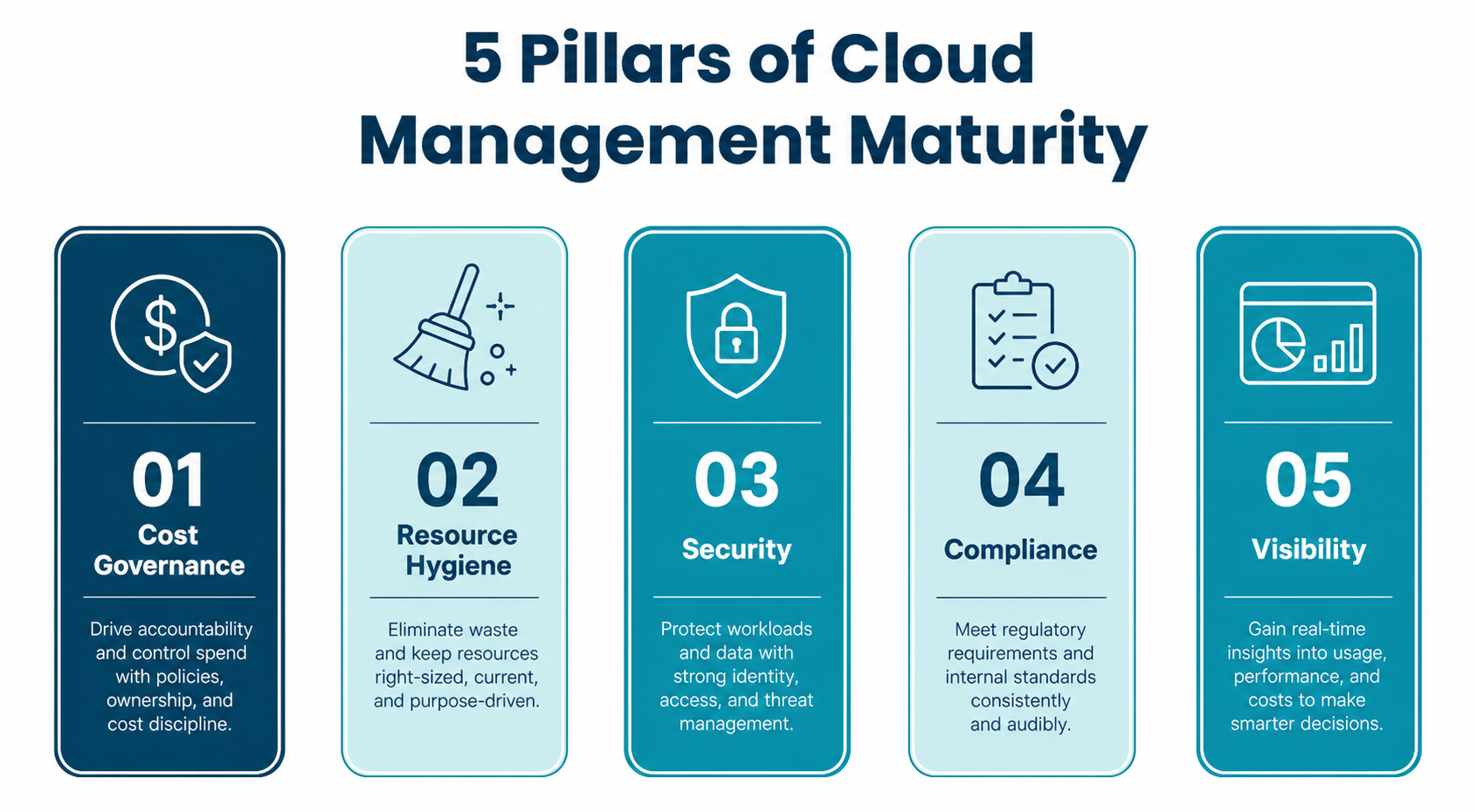
Use the self-assessment below to evaluate your cloud management maturity across five critical areas:
- Cost Governance
- Resource Hygiene
- Security Posture
- Identity & Compliance
- Operational Visibility
If you answer “yes” to multiple questions in any category, your environment may be signaling that it’s time to modernize your cloud management strategy.
The Five Pillars of Cloud Management Maturity
1. Cost Governance
The Sign: Your cloud bill is unpredictable, consistently exceeds budget, or cannot be tied to business outcomes.
One of the earliest signs your cloud environment has outgrown your management approach is when spending becomes reactive instead of strategic. Organizations struggling with cloud cost management often face inaccurate forecasting, budget overruns, and limited accountability for spending decisions.
Ask Yourself:
- Do your monthly cloud costs consistently exceed budget by 20%, 50%, or more?
- Are you unable to forecast next month’s cloud spend with reasonable accuracy?
- Do you lack budget alerts or threshold notifications in your cloud console?
- Is there no formal tagging strategy to allocate costs by team, department, or initiative?
- Are you purchasing reservations or savings plans before fully rightsizing workloads?
- Is no one clearly accountable for cloud cost overruns?
What This Looks Like in Practice
Organizations with weak cost governance often experience cloud spend exceeding approved budgets by 300% or more without automated alerts or oversight mechanisms in place.
Cloud cost management tools may exist, but they’re rarely reviewed consistently, and budgets are often set once and forgotten.
Why It Matters: Poor cloud cost governance impacts more than IT budgets. It reduces profitability, limits reinvestment opportunities, and weakens leadership’s confidence in forecasting.
2. Resource Hygiene
The Sign: You’re paying for infrastructure you’re not using and lack a process to identify or remove waste.
Unused, idle, or overprovisioned resources are among the clearest indicators that a cloud environment has scaled beyond manual management. Without proactive cloud optimization practices, what once required manual review now generates ongoing, silent waste.
Ask Yourself:
- Do you have virtual machines in a “deallocated” or powered-off state that are still incurring storage charges?
- Are unattached managed disks or orphaned snapshots sitting unused for 30+ days?
- Has your team not completed a rightsizing review in the past 12 months?
- Do 20–30% or more of your VMs show sustained low CPU and memory utilization?
- Are inactive/disabled employees still assigned paid SaaS licenses like Microsoft 365?
- Do users hold overlapping or redundant software license tiers?
What This Looks Like in Practice
Many unmanaged environments carry dozens of idle VMs, hundreds of orphaned storage assets, and inactive user licenses for months, even years, after offboarding. These aren’t isolated issues; they’re systemic indicators that resource lifecycle management is no longer operationalized.
The Opportunity: Organizations that improve cloud resource hygiene can often uncover $5,000–$12,000+ in monthly savings simply by removing idle infrastructure, rationalizing licenses, and decommissioning orphaned resources. Our Cloud Optimization Assessment helps identify and capture these savings.
3. Security Posture
The Sign: Your cloud infrastructure has public-facing exposures your team may not fully understand or actively monitor.
Security risks in cloud environments tend to accumulate gradually through misconfigurations, deferred remediation, and missing governance controls. When cloud environments outgrow their management strategy, those vulnerabilities often become systemic.
Ask Yourself:
- Are any databases or critical services configured with public network access?
- Do network security groups allow RDP or SSH access from any IP address?
- Do storage accounts or blob containers permit anonymous access?
- Have Key Vaults or secrets repositories been deployed without purge protection?
- Are core business applications running on outdated or unsupported code?
- Is there a gap between your written security policy and enforced cloud controls?
What This Looks Like in Practice
In environments operating without governance guardrails, we tend to see things like public-facing SQL servers accessible from the internet, overly permissive firewall/security rules, anonymous storage access bypassing authentication, and secret management tools without deletion protection. These are patterns, not exceptions.
Why It Matters: These conditions significantly increase exposure to ransomware, data breaches, compliance violations, and reputational damage.
4. Identity & Compliance
The Sign: Privileged access is loosely managed, and compliance depends more on assumptions than verification.
As cloud environments scale, identity governance is often one of the first management disciplines to break down. Without automation and oversight, privileged accounts accumulate, password policies weaken, and compliance gaps remain hidden until audit time, or worse, until a breach occurs.
Ask Yourself:
- Do service or admin accounts have passwords older than 90 days?
- Are privileged accounts regularly monitored and audited?
- Is MFA enforced for all administrative access?
- Does every privileged account have documented ownership?
- Are elevated-permission accounts still active without business justification?
- Can you produce an accurate access inventory across cloud and SaaS systems?
What This Looks Like in Practice
In poorly governed environments, password ages may extend into the thousands of days, admin accounts remain active long after ownership changes, MFA is optional rather than enforced, and privileged access grows without lifecycle management.
Why It Matters: The environment may appear compliant on paper, but in practice, it remains vulnerable and legally exposed.
5. Operational Visibility & Governance
The Sign: Your team is constantly reacting to issues instead of proactively managing the environment.
Strong cloud governance is not one tool or one policy. It’s an operational framework.
When governance is absent or inconsistent, cloud complexity compounds quickly.
Ask Yourself:
- Is your cloud architecture documented and up to date?
- Do you have a formal tagging/ownership governance framework?
- Are route tables, subnets, and network configs reviewed regularly?
- Is there a strategic cloud roadmap aligned with business goals?
- Are legacy workloads operating without modernization plans?
- Does your team struggle with siloed systems or fragmented data?
- Are repetitive manual tasks still unevaluated for automation?
- Are you prepared to support AI/analytics initiatives with your current infrastructure?
What This Looks Like in Practice
Configuration drift (where deployed infrastructure no longer matches documented or intended design) is one of the most common and costly signs of governance breakdown. Unused subnets, orphaned route tables, and unowned resources accumulate quietly.
Why It Matters: Without operational visibility, waste and risk reappear quickly, even after cleanup efforts.
How to Interpret Your Results
Use your answers to gauge your current cloud management maturity:
0–5 Yes Answers: Your cloud management strategy is likely functioning well, though ongoing reviews are still recommended.
6–10 Yes Answers: Some areas may require optimization before inefficiencies and risks escalate.
11+ Yes Answers: Your cloud environment has likely outgrown its current management approach and may require a more modern cloud governance framework.
What a Modern Cloud Management Strategy Looks Like
A mature cloud management approach should provide:
- Continuous Cost Monitoring: Real-time insight into spend, forecasting, and budget accountability.
- Automated Governance Policies: Controls that prevent drift, enforce standards, and reduce human error.
- Security & Compliance Monitoring: Proactive oversight to identify and remediate risk before incidents occur.
- Rightsizing & Optimization Reviews: Regular workload assessments to eliminate waste and improve performance.
- Strategic Roadmapping: A long-term cloud strategy aligned with evolving business priorities.
If these practices are absent or handled informally, your organization may already be experiencing management breakdown.
Real-World Examples of Cloud Optimization in Action
Here’s what organizations often uncover when they reassess their cloud environments:
Idle Compute Waste
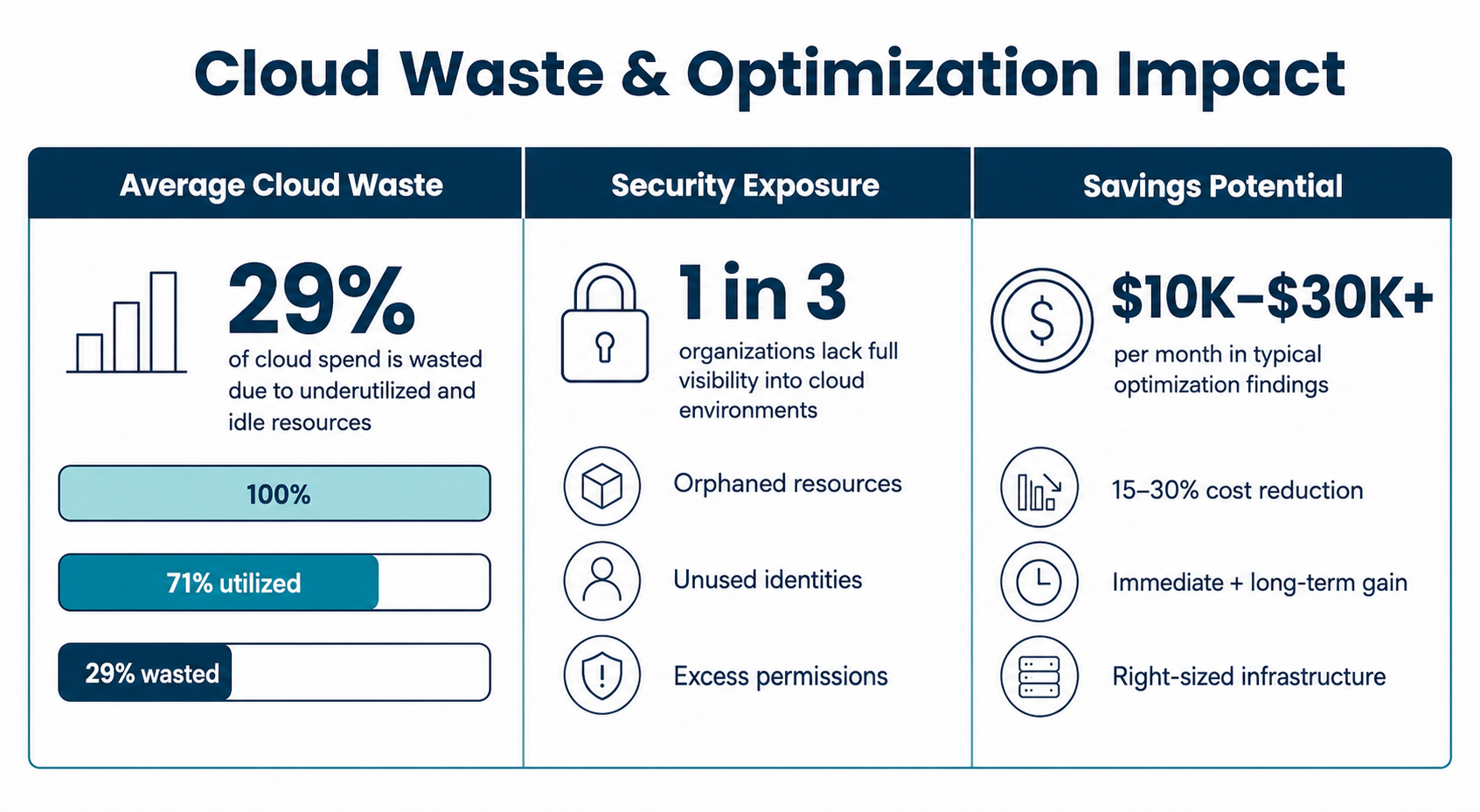
In one Azure environment, Bluewave identified over 100 powered-off VMs still generating charges, resulting in $10,007/month in projected savings through retirement of unused compute and associated storage.
License Waste
One client uncovered $29,701/month in avoidable recurring spend due to overlapping Microsoft 365 licenses and active licenses assigned to disabled users.
Security + Cost Exposure
Another organization discovered 49.5% of storage accounts allowed anonymous access, 93.3% of key vaults lacked purge protection, and cloud spend was running 313% over budget. All within a single Azure environment.
Is Your Cloud Environment Showing These Signs?
If several of these warning signs feel familiar, the next step is not just confirming that your environment has become harder to manage. It is understanding where that complexity is quietly turning into unnecessary spend.
In our next article, we break down five of the most common sources of wasted cloud spend IT teams miss until the costs are already adding up.
Schedule Your Cloud Assessment Today
Discover where your cloud environment may be costing more than it should.
Our Cloud Assessment framework helps organizations:
- Identify hidden cloud waste
- Improve security posture
- Strengthen governance controls
- Optimize infrastructure performance
- Build a strategic roadmap for future growth
FAQs: Cloud Management Strategy and Governance
Q: What is cloud management?
A: Cloud management is the process of monitoring, governing, optimizing, and securing cloud infrastructure, applications, and costs across public, private, and hybrid cloud environments.
Q: Why is cloud management important?
A: Cloud management helps organizations control spending, improve security, maintain compliance, and ensure cloud resources align with business objectives.
Q: How do I know if my cloud environment is inefficient?
A: Signs of cloud inefficiency include rising costs, idle resources, weak security controls, inconsistent governance, and poor visibility into infrastructure performance.
Q: What causes cloud waste?
A: Cloud waste is commonly caused by overprovisioned resources, unused virtual machines, orphaned storage, duplicate licenses, and lack of governance policies.
Q: What is cloud governance?
A: Cloud governance is the framework of policies, controls, and standards used to manage cloud usage, spending, security, and compliance.
Author
Kristofor Hogaboom brings 25+ years of experience designing and...
Read Full Bio

