
According to a recent commissioned study by Forrester, 72% of globally surveyed companies report exceeding their cloud budgets. AI pilots often look simple and affordable: a copilot add-on here, a proof-of-concept there, and a vendor demo that fits neatly into this year’s budget.
Then the quiet charges begin to land. SaaS tools roll out AI surcharges across dozens or hundreds of users. Data starts moving between clouds in ways it never did before. Storage grows as teams keep “temporary” logs, embeddings, and sandboxes. API consumption shifts cost from fixed licenses to variable bills that spike when pilots get popular. Meanwhile, experiments that never reach production still consume tools, environments, and staff time.
Individually, each line item seems reasonable. Together, they turn into AI cost creep that is hard to explain to a CIO or CFO. With Gartner forecasting worldwide GenAI spend to grow by more than 75%, the challenge of managing AI spend is intensifying.
Here, we walk you through where these hard-to-find budget lines show up and what IT leaders can do to keep AI spend under control once the pilot succeeds.
Most AI business cases center on the obvious purchase: a model subscription, a platform license, or an AI feature inside an existing tool. That is only the first link in a chain.
Once teams begin using AI, supporting systems expand around it:
Finance sees the license. IT feels the rest: compute, storage, data engineering, and operational overhead spread across multiple budgets. This split ownership is one reason AI value can be hard to measure and defend. Different leaders see different parts of the cost stack.
If you treat AI as a single line on a spreadsheet, you miss where the real budget pressure begins.
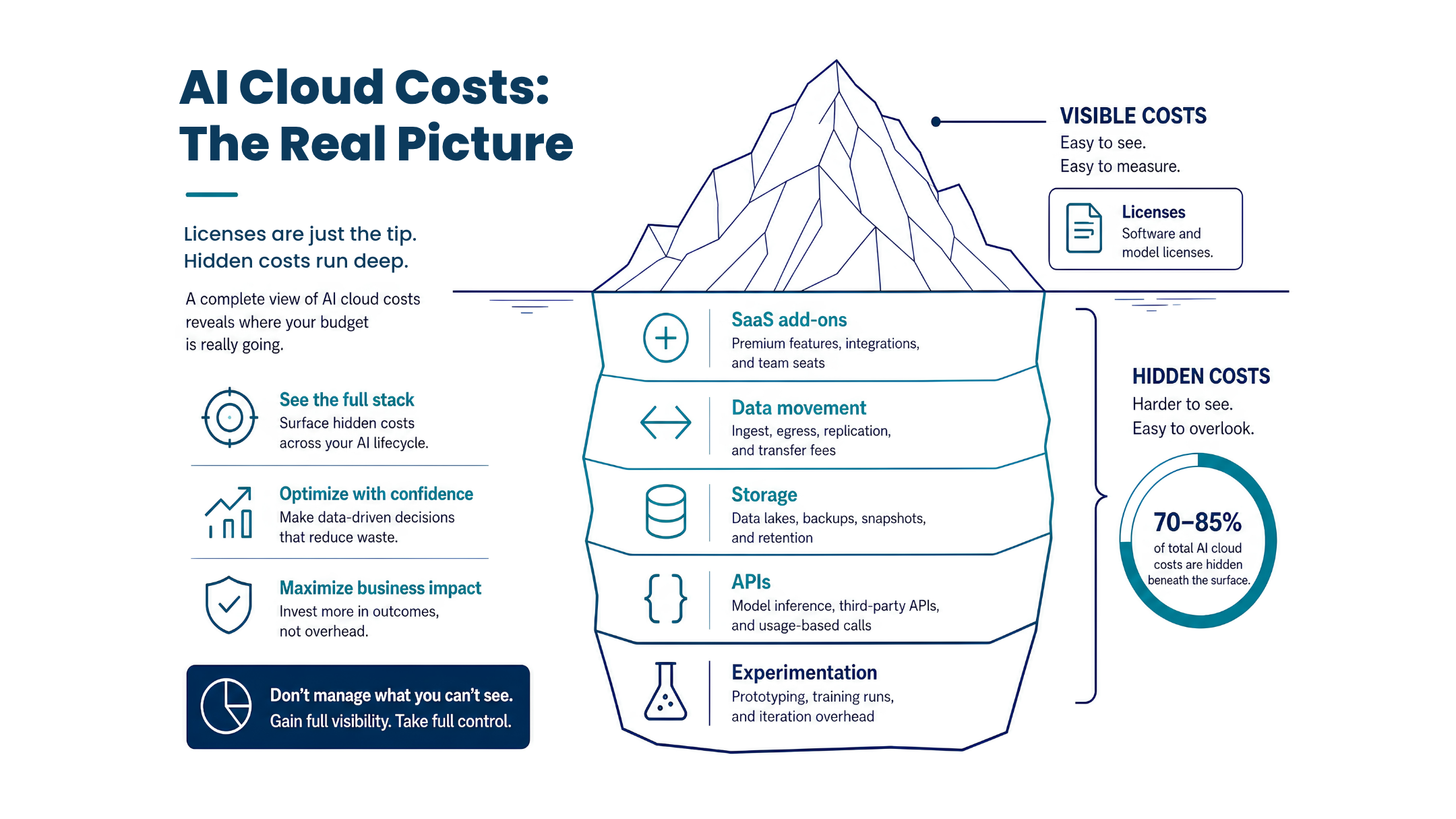
AI features in SaaS platforms are increasingly sold as premium add-ons, often priced per user or per environment. On their own, these uplifts can feel modest. The risk lies in how quickly they multiply.
Common patterns that drive AI cost creep in this area are broad enablement without a plan, layered surcharges across the stack, and overlapping capabilities.
To regain control, organizations need to
As AI use cases grow, they pull on data that was never designed to move this frequently or this broadly. The result is a quiet rise in integration and network spend. These costs tend to show up with connectors and integration platforms, cloud egress and inter-region traffic, and data replication and synchronization.
The more real-time the use case, the more frequent and expensive the movement becomes.
Organizations can reduce data-movement spend by
Even if your AI model is external, your data footprint is local. AI programs create more of almost everything: prompts, logs, embeddings, vector indexes, model outputs, and retained conversation histories.
AI quietly inflates storage through “temporary” sandboxes that never get cleaned, excessive retention (keeping logs, traces, and interaction histories “just in case” they are needed for future tuning or audits), and default high-performance tiers that are never tiered down as the AI data ages.
Some “storage-aware” best practices for AI:
API-driven AI shifts spend from fixed licenses to usage-based billing. That flexibility is powerful, but it behaves very differently from traditional software budgeting. What makes API cost forecasting hard is that small changes have large impacts. Things like prompt volume, context length and response size, automation frequency, and downstream chaining all have effects that add up fast.
API-Driven AI Guardrails:
Most organizations try experimenting with AI across multiple teams before they have a clear production operating model. The issue here is that sandbox work still consumes budget spend.
This is because pilots and PoCs require teams to stand up their own notebooks, sandboxes, and small clusters; need data prep and engineering time; and often entail more internal labor and opportunity cost than anticipated.
Some pilots never move beyond demo stage, but their supporting infrastructure and data linger as ongoing spend.
To combat this, you need to make experimentation a managed investment:
To regain control, IT leaders need an AI-specific cost model that reflects how work really happens: across data, compute, applications, and people.
| Mapping AI Costs Across Your Stack | |
| Cloud & Infrastructure | Compute for training vs inference (including GPU/CPU, serverless, and managed AI services) |
| Storage and backup costs tied to AI datasets, logs, and embeddings | |
| Network and egress fees associated with AI traffic patterns | |
| Application & Integration | Orchestration platforms, MLOps tools, and observability services supporting AI workloads |
| Connectors and integration projects that exist primarily for AI use cases | |
| Customizations in CRMs, ERPs, and line-of-business apps to embed AI into workflows | |
| People, Process, & Vendor Management | Internal enablement and “citizen developer” programs |
| Advisory and implementation partners | |
| Ongoing support, governance, and security efforts tied specifically to AI adoption | |
Tag AI-related resources, set up chargeback or showback, and link usage to teams and products so leaders can see who is driving which part of the cost stack.
Once you have a basic map, you can start distinguishing healthy growth from wasteful spend.
Focus on these metrics, they will let you have a real conversation with finance about where AI spend is earning its keep:
To get started, you will need to aim for a simple dashboard that brings together SaaS AI add-on spend, cloud AI services, API usage, and storage tied to AI work, budget alerts and thresholds that trigger review before costs spike, and executive-level summaries that show value and spend in the same view.

Before you expand AI adoption beyond successful pilots, ask these questions:
Where have AI features already been enabled inside existing SaaS tools?
Which data sources, connectors, and storage tiers does each use case depend on?
How much of your current AI spend is experimental vs production?
What guardrails exist for API usage and token consumption?
Do you have at least a basic AI cost model that includes adjacent infrastructure and operational spend?
Organizations that treat AI as an ecosystem cost, not just a software purchase, are better positioned to control spend, prioritize the right use cases, and build a defensible ROI story.
If you are seeing AI spend spread across SaaS, cloud, storage, and experimentation, you do not have to untangle it alone. We help IT and business leaders see the full picture of AI costs and design a path forward that balances innovation with financial control.
We start by looking at your environment and assessing things like where AI features are already enabled, how data moves between systems, which storage tiers AI workloads rely on, and how much of your current spend is tied to experimentation versus production value.
From there, we work with you to:
Our goal is to give you the visibility, controls, and architecture you need so that every new AI use case strengthens your business case instead of increasing your run-rate.
Ready to see where AI spend is hiding in your environment? Check out our webinar!
A: Pilots are small and tightly scoped, so costs stay low. When you scale them, SaaS add-ons, data movement, storage, and API calls all grow, and old experiments keep costing you in the background.
A: Most often in premium AI features quietly turned on in SaaS tools, higher integration and egress fees as data moves more, and growing storage from logs, embeddings, and sandboxes that never get cleaned up.
A: Bring models to your data when you can, use shared integration patterns, and include egress in each use case’s budget. Set retention rules, auto-expire sandboxes, and move older AI data to cheaper storage tiers.
A: Give each use case an API budget, track usage from day one, and tune prompts so they are efficient. For experimentation, use clear stages and timeboxes, keep pilot and production spend separate, and re-use assets from pilots whether they ship or not.
A: Build a simple AI cost model, then track cost per use case, workflow, and successful outcome. A basic dashboard that combines SaaS AI add-ons, cloud AI services, API usage, and storage will quickly show what is driving value vs waste.

© 2026 Bluewave Technology Group, LLC. All rights reserved.