
The moment a user submits a prompt to an AI tool, data has to move between people, devices, APIs, cloud services, and models quickly enough for it to work. Your network governs that journey, and your network’s own capabilities can limit the journey.
Network infrastructure is often treated as a fixed backdrop to AI investment, even as it increasingly shapes the strategy itself. As organizations move from experiments to everyday workflows, network performance, visibility, and security increasingly determine whether AI feels dependable enough to use and whether it can scale beyond a pilot.
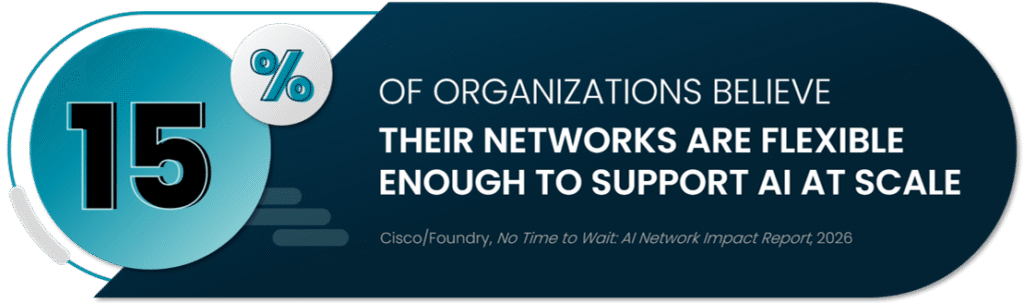
A recent study from Cisco surveyed 3,472 CIOs and technology leaders and found that only 15% of organizations said their networks were flexible and adaptable enough to support AI at the necessary scale.
This percentage points to a strategic dependency that is easy to overlook. Specifically, investments in models, GPUs, applications, and cloud platforms all rely on the network that connects users, applications, and distributed systems to one another. As AI moves into everyday workflows, things like network performance, visibility, security, and scalability increasingly determine whether those AI investments can deliver dependable results.
The question now becomes, “Can our network deliver the performance, visibility, security, and scale those tools require?”
AI readiness starts with how the network performs under real workloads. As usage grows, teams need to know whether the architecture can handle changing demand reliably. Delays, congestion, and inefficient routing can all affect an AI workflow’s response time.
Usable capacity is the bandwidth and performance available across the entire path an AI workflow depends on. Your network may have plenty of overall capacity and still deliver a poor experience. Traffic can take inefficient routes, or congestion can develop in places teams cannot easily see.
Users experience that path through the speed and consistency of an AI tool’s response. If the connection between the user, application, data, and model slows down or drops, even a capable AI service can feel unreliable. Network planning must therefore account for the complete user experience.
An AI-ready architecture gives teams the visibility and control to find potential issues and scale AI with confidence.
Traditional enterprise networks were designed for predictable application behavior. Users opened applications, requested information, and waited for a response.
AI introduces a different kind of behavior.
AI workloads can keep the network active for much longer. An agent may call several services to complete a task, while a connected device sends operational data to the cloud for analysis. Those exchanges can happen wherever work takes place, including campuses and branches that weren’t designed to sustain continuous, real-time AI demand.
That makes performance at the edge an important part of AI strategy and planning. A bottleneck at a campus or branch can have a compounding effect on the people and workflows that depend on an AI service.
Cisco research projects AI-driven traffic to reach roughly three times current levels over the next three years. The same research found that nearly 73% of organizations already face, or expect to face, campus and branch capacity limitations within 24 months. Together, these figures show why network readiness greatly influences how organizations move AI from experimentation into production.
AI readiness starts with four questions.
Organizations need to understand how AI will affect traffic across wireless, branch, WAN, cloud, and data center environments. Historical usage provides only part of the planning picture. Teams should consider more variable demand, real-time interactions, distributed applications, and workloads that depend on consistent response times.
The goal is to plan against real business needs, starting with the AI use cases that are in your pipeline and testing whether the network can support them under realistic conditions.
AI adoption can outpace the processes designed to govern it. As teams begin experimenting with AI, visibility into how those tools interact with the network often remains fragmented. Network teams may see that a connection is available, yet lack the context to explain why an AI workflow is slow or unreliable.
End-to-end observability closes that gap by following the experience from the user through the application to the model. It helps teams determine whether a failure originates in network conditions or farther upstream in the application stack, turning guesswork into a clearer operational process.
AI expands the attack surface and introduces new governance questions. Where is sensitive data moving? Which tools are authorized? How are identities, applications, and devices segmented? Can policies be applied consistently across distributed locations?
Security belongs within the AI adoption strategy. A secure network can become one of the most important enforcement points for identity, segmentation, data governance, and policy control. It can give leaders greater confidence to move from experimentation to operational use.
AI workloads and deployment patterns will continue to change. An AI-ready architecture therefore needs flexibility alongside sufficient capacity.
Organizations can modernize in stages, beginning with an assessment of current capabilities, underused resources, legacy investments, and the highest-risk bottlenecks. The goal is to create a prioritized roadmap that improves the environment over time and directs investment toward the AI use cases that matter most.
The cost of delaying network modernization extends beyond a future technology refresh. Reactive upgrades can be more expensive and disruptive than deliberate planning. When infrastructure limits become visible, the effects can spread across the business. Work slows, and security teams have a harder time applying policy with confidence.
Competitive impact tends to follow from that operational drag. Organizations with dependable AI experiences can move promising use cases into daily practice, while those constrained by network performance remain stuck in experimentation. Over time, that gap shapes productivity and the pace of innovation.
The right response combines early visibility with deliberate prioritization. Leaders need an honest view of where their network is strong, where it is fragile, and which constraints could prevent important AI initiatives from scaling.
Leaders preparing for AI can begin with these five steps:
This approach helps you move from a vague sense that “AI will require more infrastructure” to a specific understanding of what needs to change and when to act.
AI initiatives are only as strong as the environment that carries them. Models and applications create visible value. While the network itself determines whether that value can be delivered consistently and at scale.
If AI is already raising questions or concerns in your network, the next step is to understand where the pressure will emerge and how to respond.
Check out our webinar, AI Will Triple Your Network Traffic: Can Your Architecture Keep Up?
There, we are joined by experts from Cisco and Comcast Business to explore how AI is reshaping network demand, how to assess architectural readiness, and how to prioritize modernization without unnecessary spending.
A: An AI-ready network combines the performance, security, visibility, connectivity, and data-access capabilities that AI workloads require.
A: More bandwidth addresses one part of the challenge. AI readiness also requires attention to latency, congestion, routing, observability, security, policy enforcement, and the way the full environment supports AI traffic and applications.
A: AI workloads can increase east-west communication, continuous automated traffic, real-time demand, and traffic across wireless, campus, branch, cloud, and data center environments. These patterns are more distributed and variable than many legacy networks were designed to handle.
A: Not necessarily. In many cases, organizations can start by assessing current capacity and capabilities, identifying underused or legacy resources, addressing the highest-risk constraints, and building a phased modernization roadmap.
A: Begin with a network assessment that establishes current performance, capacity, visibility, security, and connectivity gaps. Then map those findings to current and planned AI use cases so investment is prioritized around business-critical needs.

© 2026 Bluewave Technology Group, LLC. All rights reserved.