Blogs
AI-Ready Network Checklist: 7 Questions Every IT Leader Should Ask Now
by
Bluewave |
August 11, 2026

AI adoption is moving from isolated pilots into everyday workflows. As this transition progresses, your network becomes an integral part of your user experience. It carries requests to AI services, connects applications to data, and supports the devices and locations where work takes place.
For many organizations, the pressure that AI exerts on their network is already measurable.
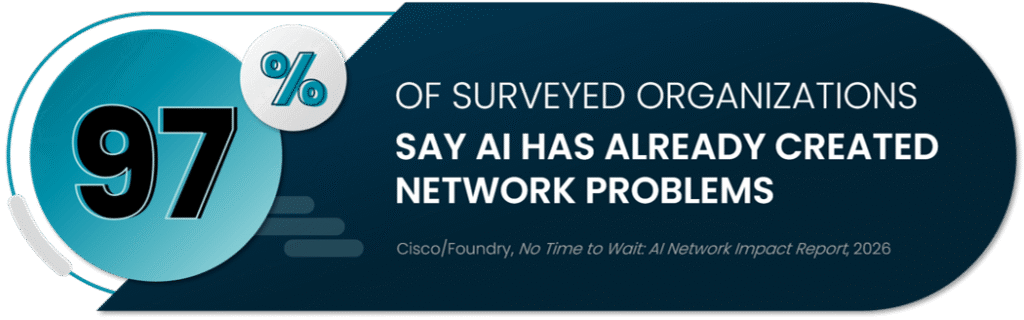
A recent Cisco survey of 3,472 CIOs and technology leaders found that 97% of respondents reported seeing AI create network challenges. In addition, 34% reported an average increase in AI-related traffic across campus and branch environments over the previous 12 months.
Here we highlight some questions you can use to identify where pressure builds in your network, and where attention may be needed before AI use expands further.
AI workflows can span a branch, campus, WAN, cloud service, and data center in a single interaction. An agent may call several services to complete a task, while other AI applications exchange data continuously in the background.
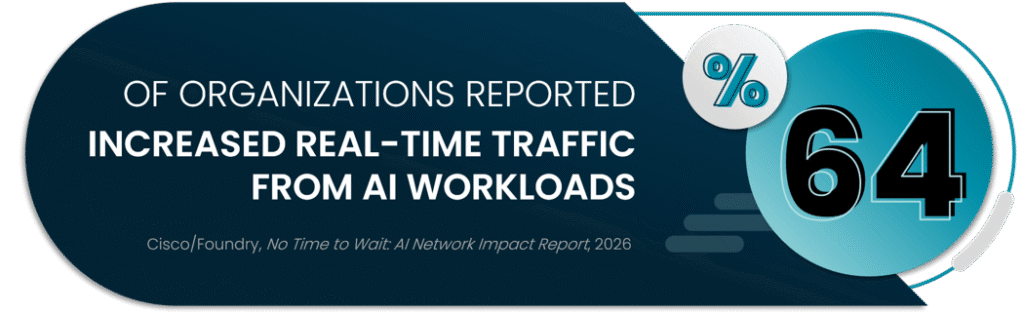
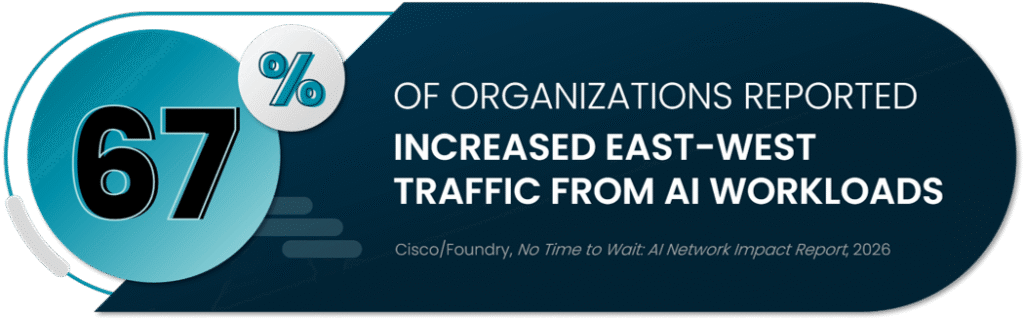
Review the major paths behind your priority use cases. Can your network team map how users, devices, applications, data, and models connect? Cisco found that 67% of respondents saw more east-west traffic tied to AI workloads, while 64% reported more real-time or latency-sensitive traffic. Those patterns make it important to evaluate the architecture as a connected system rather than checking isolated links.
Network readiness signal: Your teams can map critical AI paths and identify likely bottlenecks before deployment.
Availability alone does not describe the AI experience. A service can be reachable while response times vary enough to disrupt a workflow. Evaluate routing, latency, reliability, packet loss, and performance across the full path to determine whether priority AI workflows can meet their response-time and reliability requirements.
For example, AI training and inference can require substantial bandwidth in both directions. Edge-generated data, such as security-camera footage, medical imaging, or transportation data, may need to travel upstream for processing, while distributed AI applications remain sensitive to latency and delayed uploads. In these workflows, a healthy connection depends on the performance of the route between the source and the AI service.
Your network and infrastructure teams should measure that route from the locations where priority workflows run and compare the results with each workflow’s response-time needs. This makes it easier to identify where a problem originates.
Network readiness signal: Network teams can measure and explain the end-to-end experience for priority AI use cases, including where performance changes by location or time of day.
AI introduces new questions about who can use which tools, what data can be shared, and how traffic should be isolated. Review identity controls, segmentation, access policies, and protections for sensitive data to confirm that they can be enforced consistently across approved AI use cases and activity outside formal procurement channels.
Security complexity is one of the leading network challenges associated with AI. That makes policy readiness essential: network and security teams need to know whether their controls can keep pace as approved use cases expand and employees experiment with new tools.
Network readiness signal: Network and security teams share a current view of approved users, tools, data flows, and enforcement points.
AI can only deliver useful results when it can access the business context behind a request. That context may be distributed across the enterprise, with some data generated at the edge. For each priority use case, you should trace how information moves from its source to the application or model that uses it.
This is especially important in campus and branch environments, where operational data is created close to employees, customers, and connected devices. Local network conditions influence both the speed of that journey and the controls applied as the data moves.
Network readiness signal: Data owners, application owners, and network/infrastructure teams understand where required data resides, how it moves, and where latency or exposure could affect the use case.
Node-level alerts rarely explain the complete experience of a distributed AI workflow. Observability should follow the path from the user and device through applications, APIs, cloud services, and models.
That visibility helps teams determine whether a problem originates in the network or elsewhere in the application stack. It also speeds triage and clarifies ownership. The visibility gap is already apparent, with many organizations already reporting blind spots in monitoring and visibility, making end-to-end observability a practical readiness requirement.
Network readiness signal: Teams can distinguish a network issue from an application, API, cloud, or model issue.
AI reaches people through the places where they work. Review wireless coverage and density, roaming, branch connectivity, resilience, and the performance of connected devices at high-demand sites.
Location-level data can help teams distinguish a broad modernization need from a smaller number of priority sites. Review wireless performance, branch connectivity, resilience, and device behavior at the places where AI-enabled work will occur, especially during peak demand.
Network readiness signal: Teams have location-level performance data and a plan for sites where AI demand is expected to grow.
Historical usage provides a useful baseline for previous network traffic patterns, but it can’t capture every change AI may bring. Model demand around the use cases in your pipeline, expected adoption, agentic workflows, automation, and traffic between systems.
Planning should also account for how quickly these workloads may expand. With many organizations preparing to increase agentic AI deployment over the next 24 months, capacity decisions should align with adoption milestones and business priorities.
Network readiness signal: Leaders have a capacity forecast tied to business use cases, locations, adoption timing, and measurable assumptions.
Group each answer into one of three categories: ready, needs attention, or unknown. An unknown can be as important as a known gap because teams cannot plan confidently without visibility.
Prioritize findings by business impact, urgency, and effort. Then validate the highest-priority issues before committing to broad upgrades. The result should be a focused modernization roadmap connected to the workloads the business actually intends to scale.
Keep in mind, this checklist is a starting point for better planning. If your answers revealed uncertainty around capacity or visibility, a network assessment can help turn those findings into actionable priorities.
For a deeper look at how AI is changing network demand and what architectural readiness requires, check out our webinar: AI Will Triple Your Network Traffic: Can Your Architecture Keep Up?.

© 2026 Bluewave Technology Group, LLC. All rights reserved.